A powered exoskeleton is a wearable machine that supports, assists, or amplifies a person’s movement. Once chiefly a science-fiction image, exoskeletons are now used in rehabilitation clinics, tested in workplaces, and developed for home mobility. Their everyday promise is real but measured: clinical studies show that some people with spinal cord injury can walk with powered devices under supervision, while workplace trials suggest certain systems can reduce physical strain. Yet cost, training, safety, comfort, and limited evidence for long-term independent use still shape how widely they can help.
How exoskeletons support everyday movement
An exoskeleton is an external wearable structure aligned with the body’s joints. A powered model uses motors or other actuators to provide movement or force; a passive model relies on springs, elastic elements, or rigid supports to redistribute load without a motor. The U.S. Food and Drug Administration (FDA) describes powered exoskeletons as prescription devices intended to help certain people with lower-limb disabilities stand and walk, typically with assistive devices and trained supervision.
That definition covers several distinct categories rather than one universal “robot suit.” Lower-limb systems assist standing, stepping, or walking; upper-limb systems support the shoulder, arm, or hand; and industrial exoskeletons aim to reduce the effort of particular work tasks. Soft exosuits use flexible textiles and cables rather than a rigid frame. The best device depends on the wearer, task, environment, and clinical or workplace goals.
Powered mobility and rehabilitation
A powered lower-limb exoskeleton senses a user’s intended movement or responds to controls, then drives joints such as the hips and knees. Devices in this category may support standing, stepping, or gait training for people with conditions including spinal cord injury. They are not equivalent to a normal, unaided walking ability: users often need crutches or a walker, a trained companion, and a suitable, relatively controlled environment.
A 2016 systematic review in the Journal of NeuroEngineering and Rehabilitation examined 14 studies involving 111 people with spinal cord injury. It found that participants could walk with wearable powered exoskeletons, but also reported frequent adverse events, most commonly skin problems, and emphasized the need for more evidence. This is an important distinction: demonstrating that a device can enable steps in a study is not the same as proving it is safe, practical, or beneficial for unsupervised everyday use over the long term.
Passive supports and soft exosuits
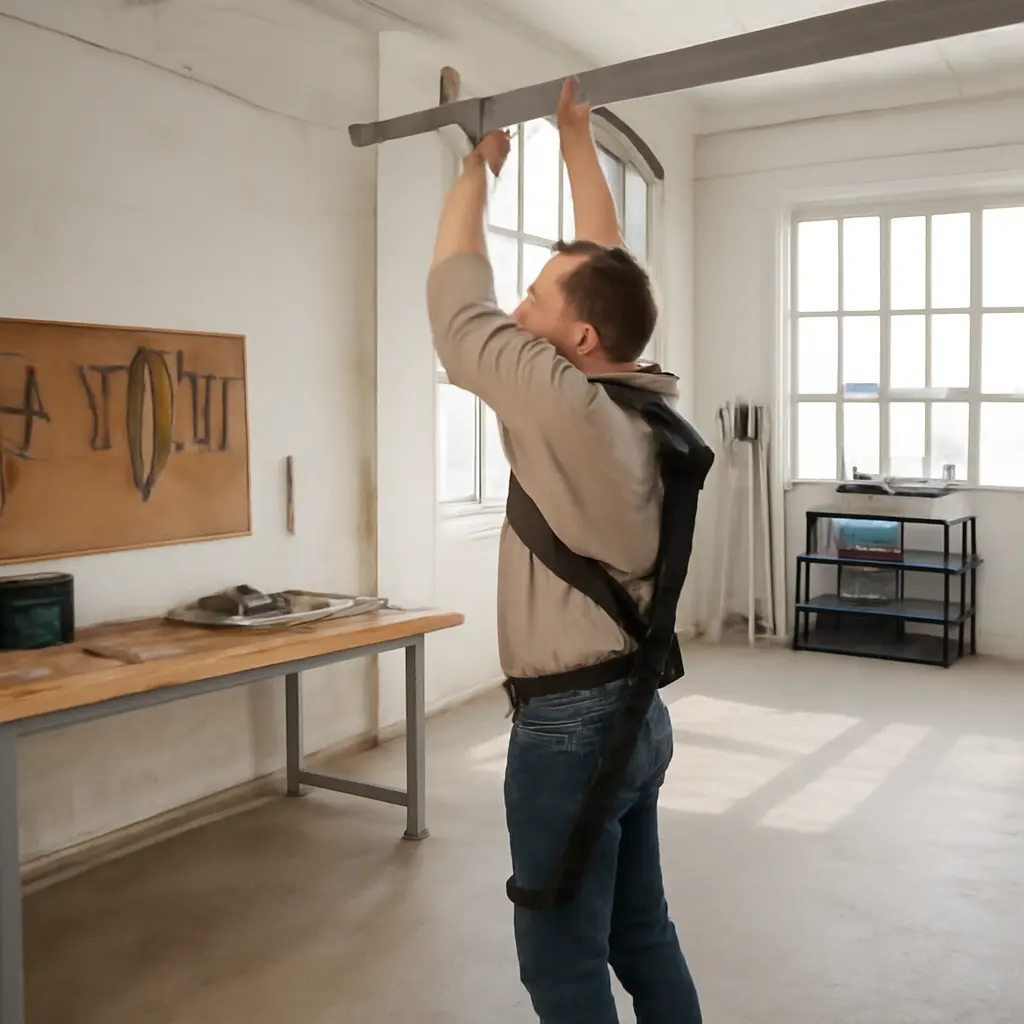
Passive exoskeletons use mechanical structures, springs, or elastic materials to transfer some load away from the body. They may support a worker’s arms during overhead tasks or reduce strain in a sustained posture, without batteries or powered joints. Soft exosuits take a lighter approach: wearable fabric and cable systems apply assistance while preserving more natural movement than a rigid frame may allow.
These designs can be useful where a task is repetitive and assistance can be targeted to a specific body area. However, “passive” does not mean risk-free or suitable for everyone. A support can shift effort to another joint, restrict movement, or fit one worker poorly. Effectiveness therefore depends on task-specific testing, fit, and monitoring—not simply on whether a device reduces effort in one measurement.
Where everyday exoskeletons are being used
Exoskeleton development is moving along two different paths: medical devices designed around a person’s mobility needs, and occupational systems intended to assist specific job tasks. The bridge between them is human factors. Both settings require a device to fit real bodies, work reliably in real environments, and provide benefits that outweigh its burdens.
Clinics and community mobility
In rehabilitation, exoskeletons can provide repeated, supported stepping practice and help clinicians work toward standing or walking goals. In the United States, the FDA has cleared or approved several powered exoskeleton devices for defined uses and populations. These authorizations apply to particular devices and indications; they should not be read as a general finding that all exoskeletons are appropriate for all mobility impairments.
Clinical use also differs from independent home use. A person may need evaluation for bone health, skin sensitivity, joint range, balance, and cardiovascular tolerance. Donning the device, transferring into it, charging it, navigating uneven ground, and responding to a malfunction all affect everyday feasibility. For many users, an exoskeleton may complement rather than replace a wheelchair or other mobility aid.
Workplaces and physical strain
At work, exoskeletons are being tested for tasks such as overhead assembly, lifting, and prolonged bending. The National Institute for Occupational Safety and Health (NIOSH) describes occupational exoskeletons as wearable devices intended to augment, enable, or assist physical activity. Its guidance stresses that employers should assess the task, worker, and workplace as a whole, since a device may reduce demand in one area while introducing pressure, restricted motion, or load elsewhere.
Work-related musculoskeletal disorders remain a major occupational health issue. The U.S. Bureau of Labor Statistics reported 946,500 cases involving days away from work in 2023 across private industry, state government, and local government. That figure covers many injury types and is not a count of injuries that exoskeletons could prevent. It does, however, show why employers are interested in evaluating tools that may reduce physical demands—alongside established measures such as job redesign, lifting aids, and appropriate staffing.
Home, aging, and daily activities
For home use, the appeal is straightforward: assistance with standing, walking, or daily tasks could support independence and participation. But home environments are less predictable than clinics. Narrow doorways, stairs, rugs, pets, fatigue, and the absence of trained help can all affect safe use. A device that performs well during a supervised session may not yet be suitable for routine use in a private home.
Aging populations and the desire to remain active are increasing interest in wearable assistance, but age alone does not determine suitability. Clinical assessment, user preference, caregiver capacity, and access to maintenance matter. For many people, conventional assistive technology—such as a cane, walker, wheelchair, or home modification—may be more practical, affordable, or reliable.
Benefits, evidence, and limitations
The case for exoskeletons rests on potential functional gains, not a guarantee of effortless movement. They can enable a particular action, provide structured training, or alter physical demands. Those outcomes should be weighed against evidence quality, device burden, safety risks, and the availability of simpler alternatives.
What the evidence supports
Research supports the feasibility of assisted walking for selected users and the potential for exoskeletons to change muscle activity or perceived exertion during specific tasks. For rehabilitation, repeated stepping may offer a way to practice movement with support. In workplaces, laboratory and field studies can identify whether a device reduces measured muscle effort or improves comfort during a defined job activity.
However, outcomes vary by device, user, task, and study design. Short trials do not establish reduced injury rates, lasting improvements in health, or cost savings. A 2022 review of occupational exoskeleton research in the Applied Ergonomics literature noted that evaluation needs to consider both intended benefits and possible unintended effects, including changes in posture, movement, and load distribution. Employers and clinicians should look for evidence that matches their specific population and use case.
Safety, comfort, and practical barriers
Potential barriers include device weight, heat, pressure points, limited battery life, complex fitting, maintenance needs, and difficulty moving naturally. Medical systems may also require screening and supervision. In occupational settings, a poorly selected device can interfere with tasks or transfer strain to another body region. Risk assessment should include the possibility that workers or users may feel encouraged to take on heavier or more repetitive tasks because assistance is available.
Cost and access are additional constraints. Prices, reimbursement, training, service, and repair vary widely by device and setting, so there is no single representative cost for “an exoskeleton.” Before adoption, users and organizations should clarify who pays for the equipment, who maintains it, what training is required, and what happens if the device is unavailable.
Choosing and evaluating an exoskeleton
A responsible decision begins with the activity that needs support, not with the device itself. The same exoskeleton may help one person or task and be ineffective or unsuitable for another. A structured trial can reveal whether assistance improves a meaningful outcome without creating new problems.
- Define the goal: for example, practicing steps, supporting an overhead task, or reducing fatigue during a specific activity.
- Review evidence and authorization for the exact model, intended user group, and setting.
- Assess fit, comfort, mobility, training, supervision, and environmental demands.
- Measure both benefits and drawbacks, including task performance, discomfort, movement changes, and safety events.
- Plan for maintenance, charging, cleaning, repair, and alternatives when the device cannot be used.
A useful comparison chart would place device type—powered medical, passive occupational, or soft exosuit—against intended task, level of assistance, supervision needs, and known limitations. Such a chart should not rank devices without specifying the user and task, because performance is context-dependent.
Conclusion: exoskeletons are tools, not magic suits
Exoskeletons have moved beyond science fiction into rehabilitation, workplace trials, and early efforts to support daily mobility. Powered systems can assist selected users with standing or stepping; passive supports and soft exosuits target particular physical demands. Evidence confirms promising capabilities, while also showing why safety, comfort, long-term outcomes, cost, and real-world usability must remain central.
The next step is careful, inclusive evaluation: involve users and workers, compare devices with simpler alternatives, and measure outcomes over time in the environments where they will actually be used. Readers considering a medical device should consult a qualified clinician and check the device’s authorized use; employers should use occupational health and ergonomics expertise before introducing a system. Exoskeletons may become valuable everyday tools, but their success will depend on fitting technology to people—not asking people to adapt blindly to technology.
Sources: U.S. Food and Drug Administration, Personal Exoskeleton Devices, https://www.fda.gov/medical-devices/consumer-products/personal-exoskeleton-devices; Miller LE, Zimmermann AK, Herbert WG, Clinical effectiveness and safety of powered exoskeleton-assisted walking in patients with spinal cord injury: systematic review with meta-analysis, Journal of NeuroEngineering and Rehabilitation, 2016, https://jneuroengrehab.biomedcentral.com/articles/10.1186/s12984-016-0154-0; National Institute for Occupational Safety and Health, Exoskeletons in the Workplace: An Overview, https://www.cdc.gov/niosh/docs/2020-102/; U.S. Bureau of Labor Statistics, Employer-Reported Workplace Injuries and Illnesses—2023, https://www.bls.gov/news.release/archives/osh_11192024.htm; de Looze MP et al., Exoskeletons for industrial application and their potential effects on physical work load, Applied Ergonomics, 2016, https://doi.org/10.1016/j.apergo.2015.11.008.